
Why Your Floors Deserve More Than a Mop and Bucket
Floor cleaning and polishing services restore dull, scratched, and worn floors to a high-gloss finish that surface-level cleaning simply can’t achieve.
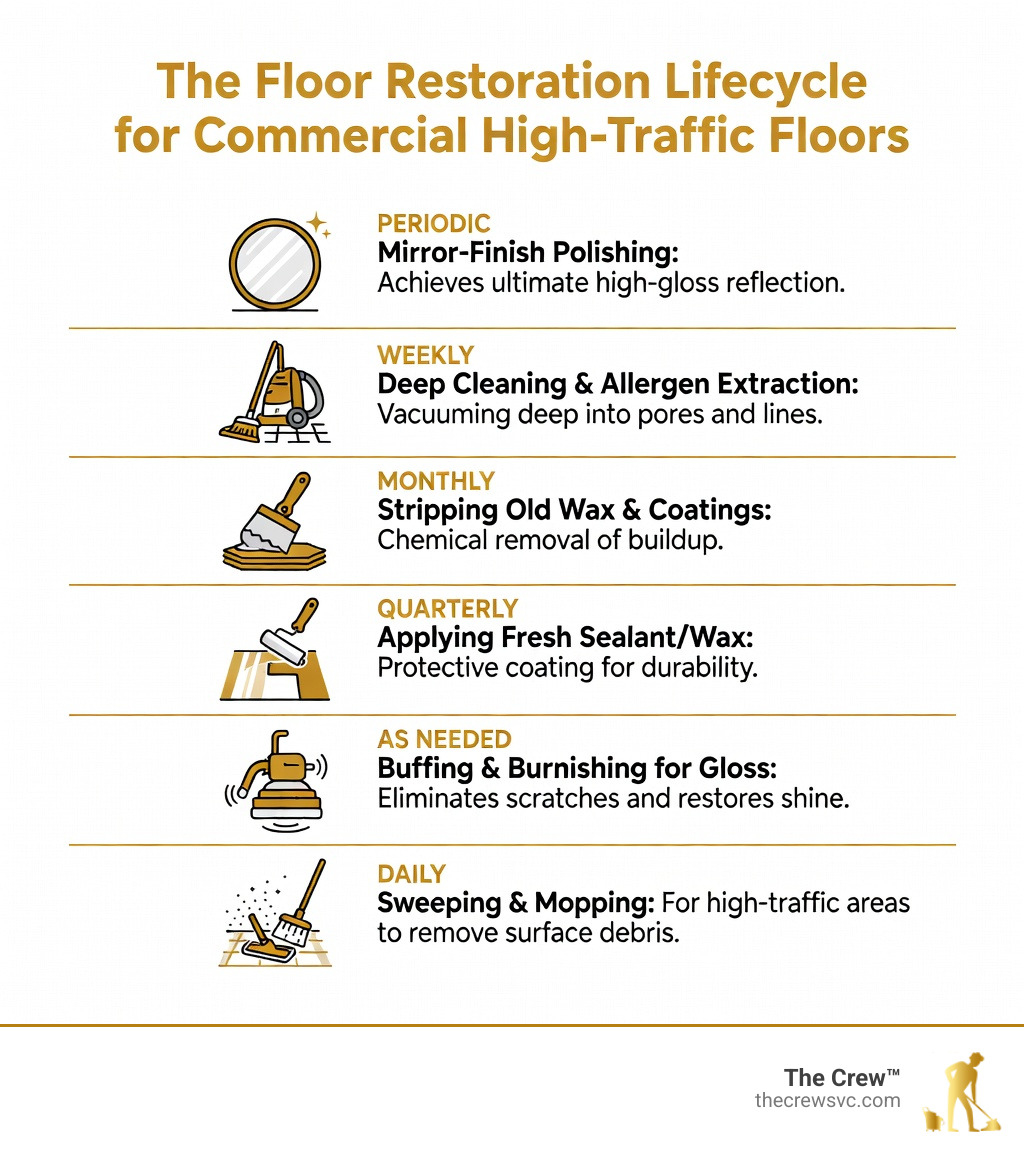
Here’s what professional floor care delivers:
- Deep cleaning that removes embedded dirt, allergens, and grime from the floor’s surface and grain
- Stripping and waxing to remove old coatings and apply fresh, protective layers
- Buffing and burnishing to eliminate minor scratches and restore shine
- Sealing to protect against future stains, moisture, and wear
- Polishing to achieve a mirror-like, reflective finish
The result? Floors that look sharp, last longer, and make the right impression on anyone who walks through your door.
Here’s the reality most business owners don’t realize: sweeping and mopping only clean the surface. Dirt, grit, and allergens work their way into grout lines, wood grain, and floor pores over time. Once that happens, standard cleaning tools can’t reach them. That’s when floors start to look dull, feel rough, and wear down faster than they should.
For a busy Denver-area business — whether it’s an office lobby, a retail floor, or a facility with heavy foot traffic — that kind of wear adds up quickly. And it shows.
I’m Carlos Castillo II, owner of The Crew™ Janitorial, a family-run commercial cleaning company serving the Denver Metro Area since 1982 — and floor cleaning and polishing services have been central to what we do for decades. In this guide, I’ll walk you through exactly how professional floor restoration works and how to get that mirror finish your space deserves.
The Science Behind Professional Floor Cleaning and Polishing Services
When we talk about a “mirror finish,” we aren’t just talking about a floor that looks wet. We’re talking about a surface so smooth and clean that light bounces off it perfectly. Achieving this isn’t just about elbow grease; it’s about science.
Every day, the average home or small office collects an incredible amount of debris. Research shows that the average home can collect up to 40 lbs of dirt, dust, and allergens each year. In a commercial setting with hundreds of people walking in and out, that number skyrockets. This debris acts like sandpaper. Every step taken on a dirty floor grinds those particles into the finish, creating microscopic scratches that scatter light. This is why floors look “dull”—the light is being absorbed by the dirt and trapped in those tiny scratches instead of reflecting back at you.
Furthermore, floors are massive filters for your indoor air. Professional floor cleaning and polishing services do more than just make things pretty; they improve health. Data shows that professional processes remove an average of 94% of allergens from carpet, 96% from hardwood, and a staggering 96.5% from tile and grout. If you want to see the full range of what we can do for your facility, check out our comprehensive cleaning services.
Why Professional Equipment Outperforms DIY Methods
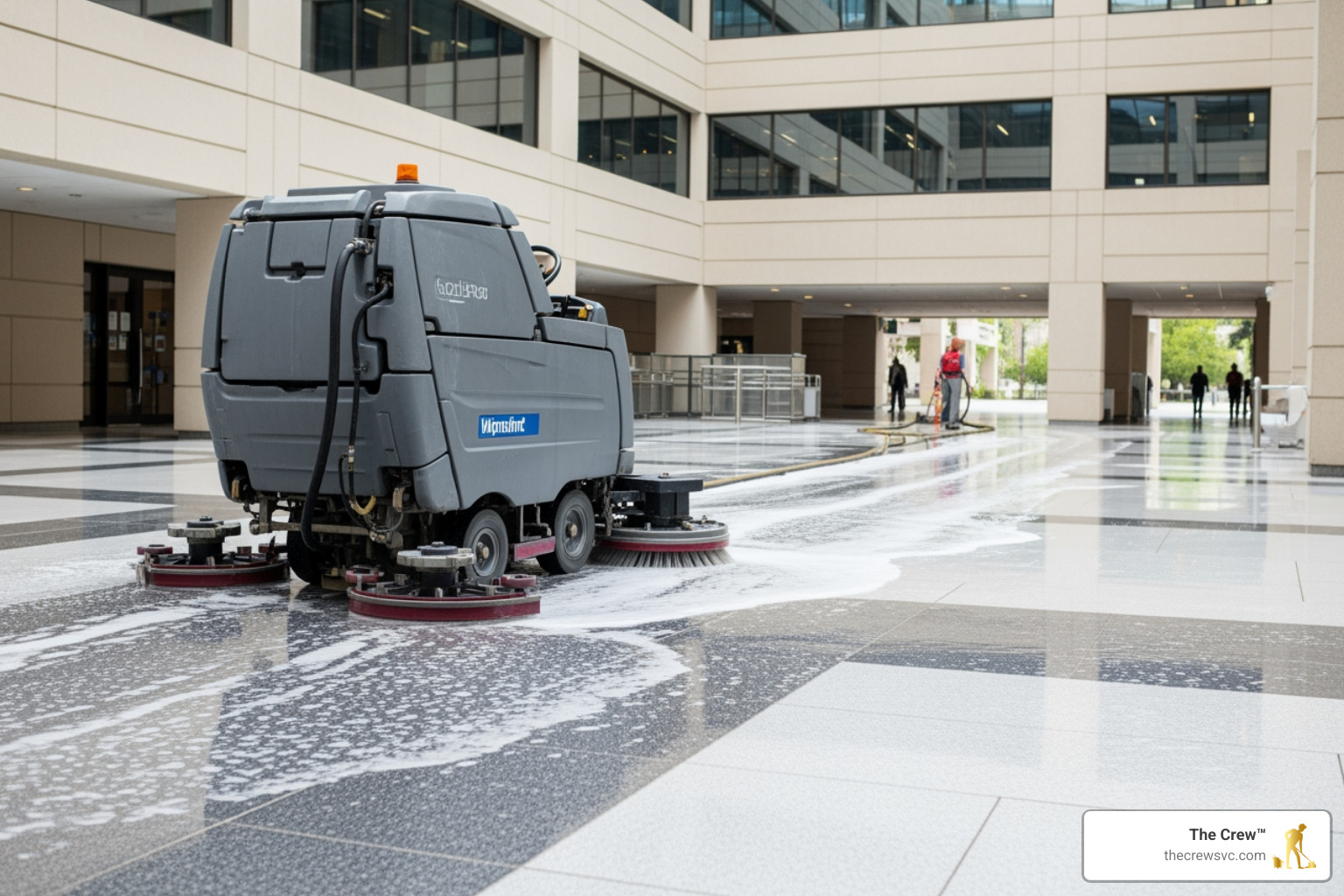
You might see a floor scrubber at a local hardware rental shop and think, “I can do that myself.” But there is a massive gap in efficiency between consumer-grade or rental machines and the industrial equipment we use at The Crew™.
Consider the numbers: Pro vacuum cleaning efficiency sits at about 82%, while home vacuums hover around 55%. When it comes to deep cleaning, professional steam cleaners operate at 91% energy efficiency compared to just 64% for home models.
| Feature | Home/Rental Equipment | Professional Grade |
|---|---|---|
| Vacuum Efficiency | 55% | 82% |
| Steam/Heat Efficiency | 64% | 91% |
| Agitation Method | Manual/Single Brush | Counter-Rotating Brushes |
| Chemical Safety | Retail/Harsh Residue | Green Certified/pH-Neutral |
| Moisture Control | High (Risk of Warping) | Low-Moisture Extraction |
Our specialized equipment uses counter-rotating brushes that reach deep into the wood grain or tile pores to pull out contaminants that a standard mop just pushes around. We often say Our Vacuums Suck (But We Don’t) because our high-powered extraction systems ensure that once the dirt is loosened, it’s actually removed from your building, not just relocated.
Removing Deep-Seated Allergens and Grime
If you’ve ever looked at your office floors and noticed the grout is turning black or the wood looks greyish, you’re looking at embedded grime. This isn’t just surface dirt; it’s a mixture of skin cells, pet dander, dust mites, and outdoor pollutants that have been compressed into the floor’s “pores.”
In commercial environments, these are often the 6 Dirtiest Areas in an Office, and the floor is the biggest culprit. We use advanced microfiber technology and hot water extraction (which is often confused with steam cleaning) to break the molecular bond between the grime and your floor. By using EPA Safer Choice certified and pH-neutral solutions, we ensure the dirt is gone without leaving behind a sticky residue that would just attract more dust the moment we leave.
A Step-by-Step Guide to the Floor Polishing Process
Restoring a floor is a journey. You can’t just slap a coat of wax on a dirty floor and expect it to shine—in fact, that’s a recipe for a yellowed, peeling mess. At The Crew™, we follow a rigorous process to ensure the results are both beautiful and durable. While it’s tempting to try this on a weekend, it’s usually better to Leave It to the Pros to avoid permanent damage.
1. Inspection and Preparation
Before a drop of water touches the floor, we perform a thorough inspection. We look for pre-existing conditions like deep scratches, water damage, or loose tiles. We also identify exactly what kind of flooring we are dealing with. Is that “wood” actually laminate? Is that “stone” actually a man-made ceramic? Using the wrong chemical on the wrong surface can lead to etching or warping.
2. Stripping and Deep Cleaning
For floors with existing wax or finish (like VCT or linoleum), we begin by stripping away the old, tired layers. This removes the yellowed buildup and any dirt trapped within the old wax. For hardwood or tile, we use deep-cleaning scrubbers to extract contaminants from the grain and grout lines.
3. Buffing and Honing
Once the floor is clean, we address surface imperfections. Buffing uses a low-speed machine to smooth out minor scratches. For natural stone floors like marble or granite, we may use diamond grinding—a process that uses diamond-infused pads to literally sand down the stone to a perfectly flat, smooth surface.
4. Sealing and Waxing
Now that the floor is “open” and clean, we must protect it. We apply high-quality sealants that penetrate the pores of the stone or grout. For vinyl floors, we apply multiple thin coats of high-solids wax. This creates a sacrificial barrier—so when people walk, they are wearing down the wax, not your expensive flooring.
5. Polishing and Burnishing
This is where the magic happens. Using high-speed burnishers, we “pop” the shine. The heat generated by the friction of the pad hardens the wax and creates that reflective, mirror-like finish.
Specialized Care for Hardwood, Tile, and Natural Stone
Every material has a personality. Hardwood, for instance, is terrified of water. If you use too much moisture, the wood will cup or buckle. We use a low-moisture process that protects the wood grain while still providing a deep clean.
Tile and grout require a different strategy. Grout is incredibly porous—think of it like a hard sponge. If it isn’t sealed properly, it will soak up every coffee spill and muddy footprint. We use specialized grout cleaners and then apply a clear or color-matched sealant to keep it looking new.
Natural stone is the most sensitive. Acidic cleaners (like vinegar, which many DIYers love) will actually eat into the surface of marble or limestone, causing “etching.” We only use pH-neutral cleaners to ensure the stone’s integrity remains intact. To learn more about our commitment to quality and our history in Denver, visit our About Us page.
Achieving a Mirror Finish with Floor Polishing Services
The “Mirror Finish” isn’t just an aesthetic choice; it’s a sign of a healthy floor. When we use high-speed burnishing (machines spinning at 1,500 to 3,000 RPM), the heat actually fuses the finish together, sealing the pores of the material. This makes the floor much more resistant to scuffs and spills.
A highly reflective surface also has a secondary benefit: it makes your space look larger and brighter. By reflecting the overhead lighting, you can often reduce the amount of artificial light needed, saving on energy costs. Plus, a polished floor is actually safer. While it looks slippery because it’s shiny, a properly polished and maintained floor often has a higher coefficient of friction (grip) than a dusty, neglected one.
Maximizing Longevity: Maintenance for Commercial and Residential Floors
Installation of new flooring is one of the biggest capital expenses for any business. Floor cleaning and polishing services are essentially an insurance policy for that investment. By maintaining a protective barrier, you extend the lifespan of the material by years, if not decades.
While we handle the heavy lifting, your daily routine matters too. To understand how professional maintenance fits into your budget, you can view our Janitorial Prices to see the value of regular care versus the high cost of floor replacement.
The Role of Entry Mats and Seasonal Care
Your first line of defense is at the door. We recommend a “two-mat system” for every entrance. First, a scraper mat outside to knock off large chunks of dirt and salt. Second, a wiper mat inside to absorb moisture and fine dust.
In Denver, seasonal care is critical. During the winter, the salt and de-icing chemicals used on sidewalks are incredibly corrosive. They can cause “pitting” in concrete and eat through floor wax in a matter of days. This salt residue creates a chalky buildup that standard mopping often can’t remove because salt requires a specific neutral pH remover to dissolve properly.
If moisture from snow seeps into the cracks of hardwood or the seams of laminate, it can weaken the subfloor and lead to mold. Moreover, as that salt and dirt dry, they become airborne, recirculating through your HVAC system and lowering your indoor air quality. Regular winter maintenance isn’t just about looks—it’s about protecting your building’s infrastructure.
Frequency and Costs of Floor Cleaning and Polishing Services
How often should you call in the pros? It depends on your “footfall”—the number of people walking on the floor daily.
- High-Traffic Commercial (Retail, Lobbies): These areas often need a “scrub and recoat” every 3 to 6 months, with a full strip and wax once a year.
- Moderate Traffic (Offices, Hallways): An annual deep clean and polish is usually sufficient to keep them looking sharp.
- Residential: Most home floors benefit from professional cleaning and polishing every 12 to 18 months.
Pricing is typically affected by the room size, the type of material, and the amount of “prep work” required (like moving furniture). However, the cost of routine cleaning is significantly lower than the cost of a total floor replacement. When you’re ready to start, make sure you Choose the Right Cleaning Service that understands the specific needs of Denver businesses.
Frequently Asked Questions about Floor Restoration
How often should floors be professionally polished?
For most commercial spaces, we recommend a professional polish at least once a year. However, high-traffic areas like grocery stores or hospital lobbies may require monthly burnishing to maintain that mirror shine. If you notice the floor looks “dull” even after a fresh mop, the finish has likely degraded and needs professional attention.
Is professional floor cleaning safe for all materials?
Yes, provided it is done by experts. We use different techniques for every surface. For example, we use minimal moisture on hardwood and laminate to prevent warping, while we use high-pressure extraction on ceramic tile. A professional inspection is always our first step to ensure we use the safest chemicals and equipment for your specific floor.
What is the difference between buffing and burnishing?
This is a common point of confusion!
- Buffing is a low-speed process (usually 175-350 RPM) used to clean the floor and remove scuffs. It restores a nice satin shine.
- Burnishing is a high-speed process (1,500+ RPM) that literally “pops” the shine by heating the wax to create a rock-hard, mirror-like gloss.
Conclusion
At the end of the day, your floors are the foundation of your business’s image. They are the first thing a client sees when they walk in and the last thing they notice as they leave. Dull, dirty floors send a message of neglect, while a mirror-finish floor screams professionalism and attention to detail.
At The Crew™, we take pride in being the Denver Metro Area’s go-to experts for floor cleaning and polishing services. We don’t use subcontractors; our team consists of background-checked, highly trained cleaners. Our 0% turnover rate means you get the same consistent, reliable service every single time we visit.
Don’t let your floors fade into the background. Let us help you protect your investment and brighten your space. Schedule Your Professional Floor Service with The Crew™ today and see the difference a true mirror finish can make.