Why Industrial Cleaning Services Are a Different Beast Entirely
Industrial cleaning services are specialized cleaning solutions designed for factories, warehouses, manufacturing plants, and other heavy-use facilities — going far beyond what a standard janitorial crew handles.
Here’s a quick look at what professional industrial cleaning covers:
- Combustible dust removal to prevent fire and explosion hazards
- HVAC and exhaust system cleaning for air quality and energy efficiency
- Equipment and machinery cleaning to reduce wear and extend lifespan
- Chemical residue and hazardous material removal using trained technicians
- High-reach and ceiling cleaning for rafters, ducts, and hard-to-access areas
- Floor restoration including scrubbing, polishing, and deep degreasing
These aren’t tasks you can hand off to a general cleaning crew with mops and spray bottles. Industrial environments involve hazardous materials, heavy machinery, and strict safety regulations that demand a whole different level of training and equipment.
The stakes are real. Dust buildup can cause equipment to overheat. Flammable particles can ignite from a single spark. Dirty HVAC systems drag down air quality and energy efficiency. And falling behind on regulatory compliance — think OSHA, NFPA, or EPA standards — can mean serious fines or shutdowns.
If your facility runs hard, your cleaning program needs to keep up.
I’m Carlos Castillo II, owner of The Crew™ and a commercial cleaning professional with decades of family-run experience delivering industrial cleaning services to businesses across the Denver Metro Area. In this guide, I’ll walk you through everything you need to know to keep your facility clean, safe, and running at full capacity.
Key Differences: Industrial vs. Janitorial Services
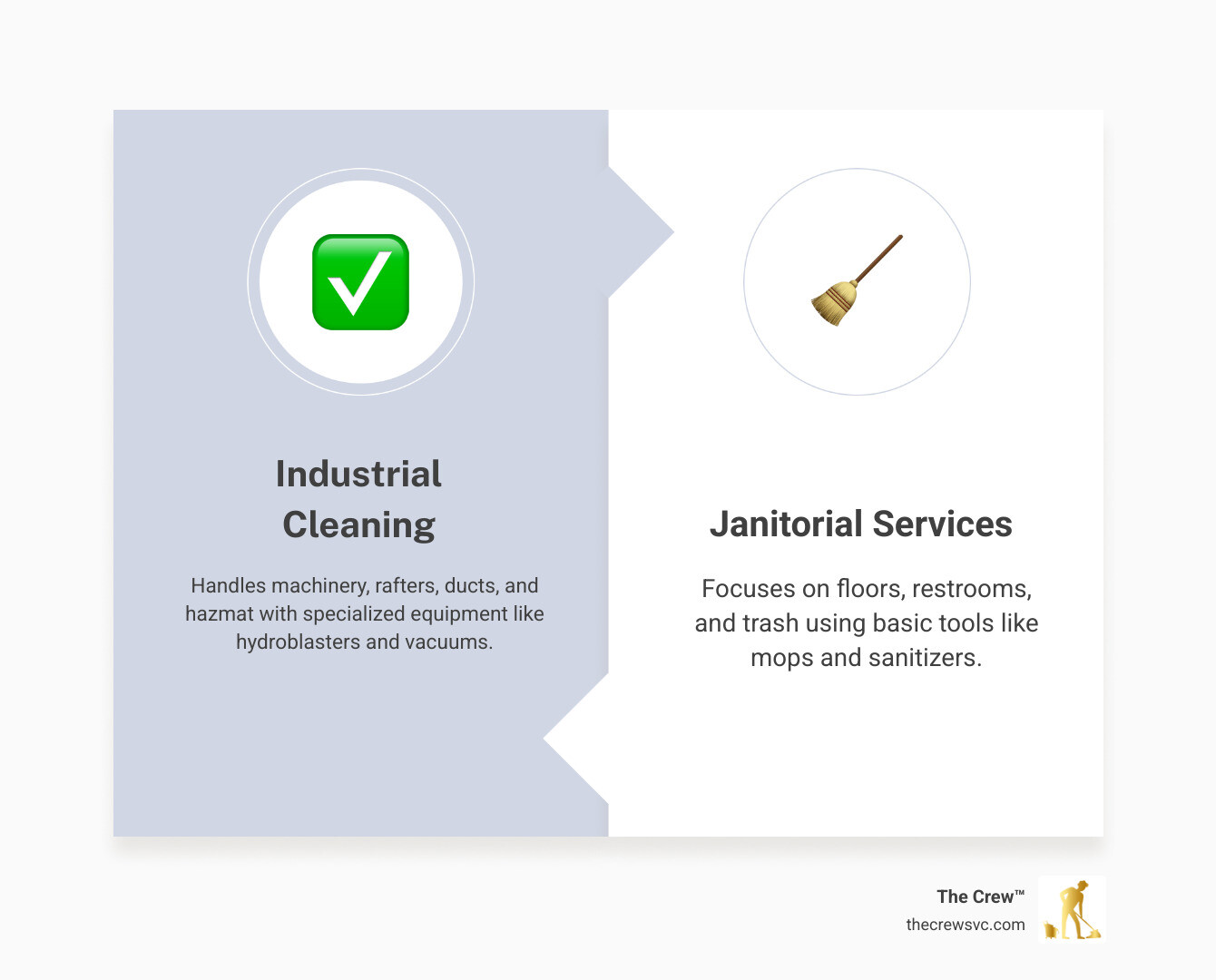
When people hear the word “cleaning,” they often think of someone emptying trash cans and wiping down desks. While those tasks are vital for an office, they barely scratch the surface of what happens in an industrial setting.
Industrial cleaning services require a specialized approach because the environment itself is inherently more dangerous. In a warehouse or factory, we aren’t just dealing with coffee spills; we are dealing with hydraulic oils, metal shavings, chemical residues, and “fugitive dust” that can settle on high rafters.
Specialized Training and Equipment
Standard janitorial crews use mops, upright vacuums, and basic glass cleaners. In contrast, industrial specialists utilize heavy-duty gear like:
- Industrial-grade floor scrubbers that can cut through layers of grease.
- Explosion-proof vacuums designed to safely collect combustible materials.
- Hydroblasting tools that use high-pressure water to strip away buildup.
- Electrostatic sprayers for comprehensive disinfection in large-scale environments.
Furthermore, the personnel must be trained in specific safety protocols. At The Crew™, we emphasize that you should Leave it to the Pros because industrial cleaning often involves working in confined spaces, using fall protection for high-reach areas, and following lockout/tagout procedures to ensure machinery doesn’t start while it’s being cleaned.
Navigating the Costs
Because of the specialized equipment and risks involved, the pricing structure for these services differs from standard office maintenance. If you are curious about how these specialized needs impact your budget, you can explore more about janitorial prices to see how different service levels are calculated.

Why Your Facility Needs Professional industrial cleaning services
It isn’t just about looking “tidy.” Professional cleaning is a fundamental pillar of operational success.
- Safety Protocols: Clean floors prevent the most common workplace injuries: slips, trips, and falls. Removing grease and oil spills immediately is non-negotiable for worker safety.
- Production Efficiency: A cluttered, dirty workspace slows down logistics. When aisles are clear and machines are free of debris, the workflow remains uninterrupted.
- Regulatory Compliance: Agencies like OSHA and the NFPA have strict rules regarding dust accumulation and chemical storage. Regular professional cleaning keeps you “audit-ready” at all times.
- Warehouse Logistics: In large distribution centers, dust can settle on inventory, damaging products before they even leave the shelf. Keeping the environment pristine protects your bottom line.
5 Essential industrial cleaning services for Modern Facilities
Modern industrial facilities are complex ecosystems. To keep them healthy, we focus on five core areas that provide the highest return on investment for safety and productivity.
1. Combustible Dust Remediation
This is perhaps the most critical service. In industries like woodworking, metalworking, or food processing, fine particles accumulate on high surfaces like rafters and ductwork. If a small fire occurs, the resulting pressure wave can shake this dust loose, creating a massive secondary explosion. We use NFPA-compliant methods to safely remove this dust without sending it back into the air.
2. HVAC and Exhaust System Cleaning
Dirty HVAC systems don’t just smell bad; they drag down indoor air quality and force your system to work harder, spiking energy bills. Cleaning these systems according to NADCA standards ensures that your employees are breathing clean air and your equipment isn’t overheating. This is especially important when you consider the 6 Dirtiest Areas in an Office or facility, where ventilation often tops the list.
3. Floor Restoration and Degreasing
Industrial floors take a beating from forklifts, heavy machinery, and chemical leaks. We provide deep scrubbing, stripping, and waxing, or concrete polishing to restore the integrity of your flooring. A well-maintained floor reflects more light, making the facility safer and brighter for everyone.
4. Chemical Residue and Tank Cleaning
Whether it’s a food-grade vat or a chemical storage tank, residues can lead to cross-contamination or corrosion. Specialized cleaning involves using the right chemical mixtures and high-pressure tools to ensure every inch is sanitized.
5. Advanced Disinfection
In the post-pandemic world, we’ve learned that COVID-19 Disinfecting: It’s Not Rocket Science, but it does require the right tools. We use EPA-registered disinfectants and electrostatic sprayers to provide 360-degree coverage of equipment and common areas, ensuring a healthy workforce.
The Role of industrial cleaning services in Equipment Maintenance
Many facility managers view cleaning as an “extra” expense, but it is actually a form of preventative maintenance.
- Friction Reduction: Dust and grit act like sandpaper on moving parts. By removing these particles, we reduce friction and prevent premature wear and tear on expensive machinery.
- Cooling Efficiency: When vents and motors are clogged with grime, they can’t dissipate heat properly. This leads to overheating and unexpected downtime.
- Machinery Lifespan: Regular cleaning extends the life of your assets. It’s much cheaper to clean a machine than it is to replace a bearing or an entire motor.
- Downtime Prevention: Scheduled cleaning during “outages” or “turnarounds” allows technicians to inspect machines more easily. It’s hard to spot a hairline crack in a gear if it’s buried under an inch of grease.
For facilities that need constant attention, The Benefits of Day Porter Cleaning Services cannot be overstated. Having someone on-site to handle spills and debris in real-time prevents small issues from becoming major maintenance headaches.
Advanced Techniques: Hydroblasting, Vacuums, and Blasting
To tackle the toughest industrial grime, we move beyond the mop bucket. Modern technology allows us to clean more effectively, often in half the time of traditional methods.
| Technique | Description | Best For | Secondary Waste |
|---|---|---|---|
| Hydroblasting | Uses ultra-high pressure water (up to 40,000 PSI) | Tanks, pipes, and removing heavy scale | Water runoff |
| Dry Ice Blasting | Blasts CO2 pellets that vaporize on contact | Sensitive electronics, food equipment | None (pellets disappear) |
| Sponge Blasting | Uses recycled sponge media at 70-100 PSI | Delicate surfaces and dust-free prep | Low (media is recycled) |
| Vacuum Excavation | High-power suction for “soft digging” | Finding underground utilities safely | Minimal |
Automated tools are also changing the game. Automated hydroblasting, for instance, can cut project time by more than 50% while keeping human operators at a safe distance from hazardous areas. We also see the rise of industrial drone inspections, which allow us to see inside chimneys or under rafters without the need for expensive scaffolding.
Safety Standards and Regulatory Compliance
In the industrial world, “clean” is a legal requirement. We operate under a strict umbrella of regulations designed to protect workers and the environment.
- OSHA Guidelines: The Occupational Safety and Health Administration sets the baseline for workplace safety. Following OSHA safety standards ensures that your facility avoids heavy fines and stays operational.
- NFPA Compliance: The National Fire Protection Association provides the standards for managing combustible dust (NFPA 652). Ignoring these can lead to catastrophic insurance liabilities.
- EPA Regulations: The Environmental Protection Agency monitors how we dispose of hazardous waste and wastewater. Using “closed-loop” systems for recycling solvents and oil is a best practice we follow.
- WHMIS and CNESST: For our friends in different regions or those handling international chemicals, following the Workplace Hazardous Materials Information System (WHMIS) ensures every chemical is labeled and handled correctly.
We also track safety metrics like DART (Days Away, Restricted, or Transferred) and TRIR (Total Recordable Incident Rate). A high-quality cleaning partner should have ratings that are significantly lower than the industry average, proving their commitment to a “safety-first” culture.
Selecting a Reliable Industrial Cleaning Partner
Choosing the right provider is a big decision. You aren’t just hiring a “cleaner”; you are hiring a safety partner. Here are the factors you should consider:
- Experience and Customization: Does the provider understand your specific industry? A food processing plant has very different needs than a chemical refinery. Look for a partner who offers a site walkthrough to create a customized plan tailored to your facility’s “quirks.”
- Insurance and Bonding: Never hire an uninsured crew. Industrial work is high-risk; you need to know that you are protected if an accident occurs.
- Background Checks: Security is paramount in industrial settings. At The Crew™, we ensure every team member is background-checked and vetted. When you Choose the Right Cleaning Service, you should insist on seeing their hiring protocols.
- Employee Retention: This is our secret sauce. High turnover in the cleaning industry leads to inconsistent results and security risks. We pride ourselves on 0% turnover among our top cleaners, meaning the same reliable faces will be on your site every time.
- Bilingual Communication: In diverse workforces, the ability to communicate safety protocols in multiple languages is a major asset for preventing misunderstandings.
- Service Frequency: Whether you need daily maintenance, quarterly deep cleans, or support during a “turnaround” (a scheduled plant shutdown), your provider should be flexible enough to work around your production schedule.
Frequently Asked Questions about Industrial Cleaning
What is the difference between industrial and commercial cleaning?
Commercial cleaning generally focuses on public-facing or office spaces (retail, offices, schools). Industrial cleaning focuses on hazardous environments like factories and warehouses, requiring specialized machinery, chemicals, and safety certifications to handle things like heavy grease, combustible dust, and machinery maintenance.
How does industrial cleaning improve equipment lifespan?
By removing abrasive dust, preventing clogs in cooling vents, and reducing friction on moving parts, industrial cleaning prevents overheating and mechanical failure. It allows machines to run at peak efficiency, delaying the need for costly replacements.
What safety certifications should a cleaning provider have?
A reputable provider should be compliant with OSHA (safety), NFPA (fire/dust), and EPA (environmental) standards. They should also provide proof of WHMIS training for chemical handling and have technicians trained in specific tasks like confined space entry or high-fall protection.
Conclusion
At the end of the day, industrial cleaning services are about more than just aesthetics—they are about the health of your business. A clean facility is a safe facility, and a safe facility is a profitable one.
At The Crew™, we’ve spent years perfecting our approach in the Denver Metro Area. We know that reliability is everything in this industry. That’s why we focus on hiring the best people, performing rigorous background checks, and maintaining a 0% turnover rate. When we show up to your warehouse or plant, we bring the expertise and the “white-glove” mindset required to keep your operations running smoothly.
Don’t let your facility fall behind. Whether you need a one-time deep clean for an upcoming audit or a long-term maintenance program, we are here to help.
Ready to see the difference a professional crew can make? Explore our full range of Services and let’s get your facility back to its peak performance.