
The $90 Billion Industry You Can Actually Build a Business In
Starting a commercial cleaning business is one of the most accessible paths to entrepreneurship — but it is far from the easiest.
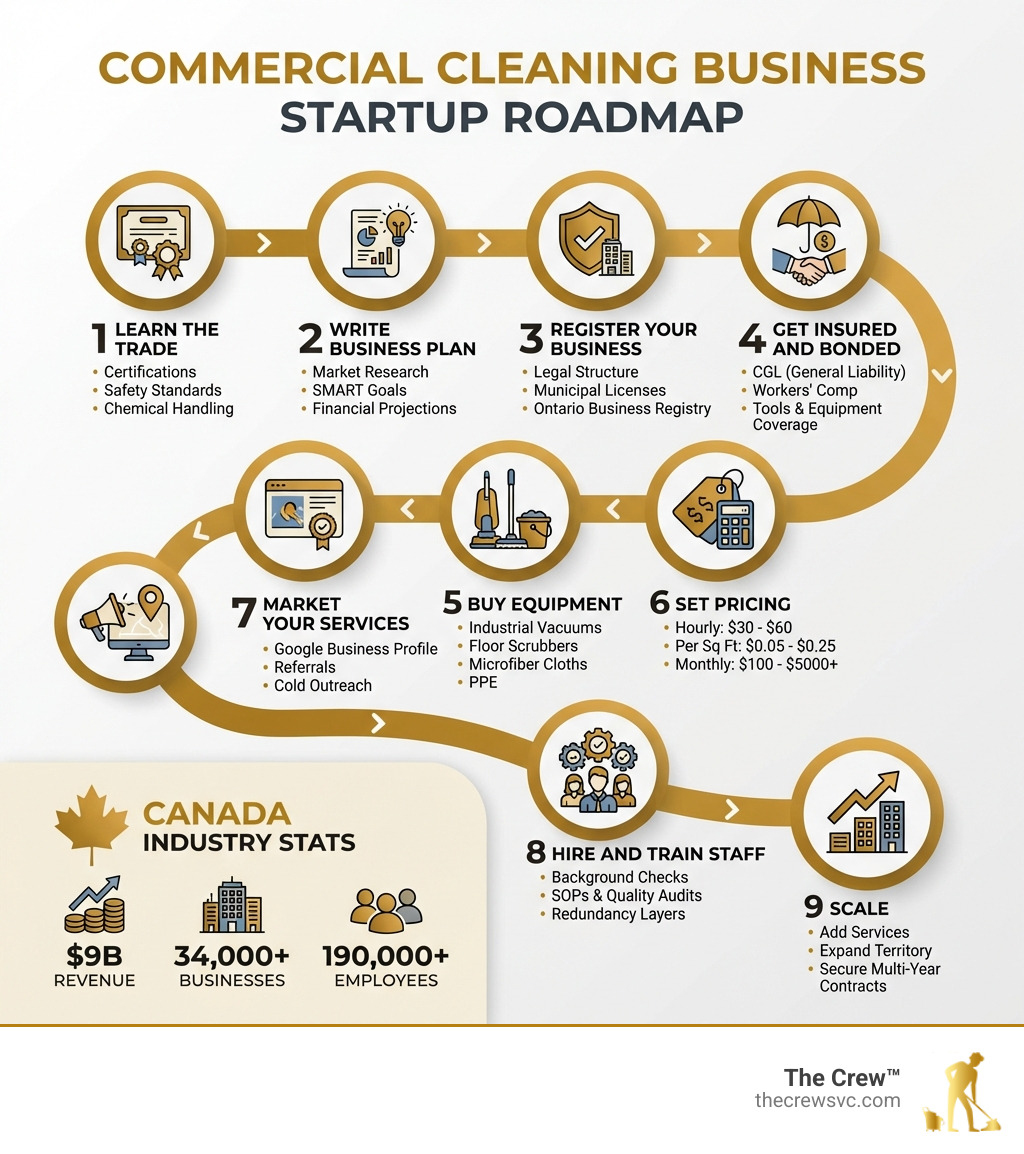
Here is a quick overview of what you need to know to launch and grow one successfully:
| Step | What It Involves |
|---|---|
| 1. Learn the trade | Skills, certifications, safety standards |
| 2. Write a business plan | Market research, goals, financial projections |
| 3. Register your business | Legal structure, licenses, municipal permits |
| 4. Get insured and bonded | General liability, workers’ comp, bonding |
| 5. Buy equipment | Vacuums, floor scrubbers, PPE, chemicals |
| 6. Set your pricing | Hourly, per sq. ft., or flat monthly rate |
| 7. Market your services | Google profile, referrals, cold outreach |
| 8. Hire and train staff | Background checks, SOPs, quality audits |
| 9. Scale | Add services, expand territory, build contracts |
The commercial cleaning industry in the United States generates over $90 billion in annual revenue, supports over 1 million employees, and includes thousands of businesses — with Colorado being a key growth market for active cleaning companies. Demand is steady, contracts are recurring, and the market is far from saturated with high-quality operators.
But here is the part most startup guides skip: the day-to-day reality of running a cleaning business is genuinely tough. Staffing is unpredictable. Clients are demanding. Margins shrink fast if you price wrong or lose a contract over something as small as a single missed window.
This guide covers all of it — the opportunity and the hard truth.
I’m Carlos Castillo II, owner of The Crew Janitorial, a family-run commercial cleaning business serving the Denver Metro Area since 1982, which I now lead with a focus on background-checked staff, zero turnover, and customized cleaning solutions. My background in Finance from the University of Colorado Boulder, combined with hands-on operational leadership, gives me a grounded view of what it actually takes to build a cleaning company that lasts.
The Reality of Launching a Commercial Cleaning Business
Launching a commercial cleaning business is often romanticized as a “low-cost, high-profit” venture. While the entry barriers are lower than opening a tech firm, the operational reality is a grind. Success starts with rigorous market research. You aren’t just competing with other professionals; you’re competing with “trunk slammers”—uninsured individuals working for cash who undercut legitimate businesses.
In Colorado, labor rates vary depending on the region. In major hubs like Denver or Aurora, the cost of living forces wages higher, often several dollars above the state minimum. If you want reliability, you have to pay for it.
Your first formal step is creating a business plan. This shouldn’t be a dusty document; it needs to include SMART goals (Specific, Measurable, Attainable, Relevant, and Time-bound). For example, “Secure three recurring office contracts within 90 days” is a goal; “Get more clients” is a wish.
You must also decide on a legal structure. Most owners opt for an LLC to protect personal assets. Once decided, register through the Colorado Secretary of State and check with your local municipality for specific licenses. Unlike residential cleaning, commercial work often requires you to find top vetted cleaners who can pass background checks, as they will have keys to buildings containing sensitive data and expensive equipment. For a comprehensive starting point, review the Small Business Administration checklists.
Essential Equipment for a Commercial Cleaning Business
You cannot clean a 10,000-square-foot warehouse with a vacuum meant for a living room. Commercial-grade equipment is a non-negotiable investment. At the very least, your “starter kit” should include:
- Industrial Vacuums: Look for HEPA-filtered units with high suction. We like to say our vacuums suck but we don’t because quality equipment is the difference between a clean floor and a dusty one.
- Floor Scrubbers: For large retail or industrial spaces, walk-behind scrubbers save hours of manual labor.
- Microfiber Everything: These are more effective at trapping pathogens than traditional cotton cloths.
- PPE and Chemicals: You must adhere to OSHA safety standards regarding chemical handling. This includes keeping Safety Data Sheets (SDS) for every chemical on-site and ensuring staff wear appropriate gloves and masks.
Navigating Insurance and Liability
In the commercial cleaning business, insurance isn’t just a safety net; it’s a ticket to the game. Most property managers won’t even let you through the door without a certificate of insurance.
Essential coverages include:
- Commercial General Liability (CGL): Protects you if a staff member accidentally floods a bathroom or a client trips over a mop bucket.
- Bonding: This protects the client against employee theft.
- Workers’ Compensation: Mandatory in Colorado to cover medical costs if an employee is injured on the job.
- Tools vs. Equipment Coverage: Insurance companies often categorize items under $1,500 as “tools” and those over as “equipment,” which affects how they are scheduled on your policy.
To truly stand out, aim for the Cleaning Industry Management Standard (CIMS) certification. It validates that your business follows industry best practices for management and service delivery.
Pricing Strategies and Average Rates in Colorado
Pricing a job incorrectly is the fastest way to go out of business. If you bid too high, you lose the contract; bid too low, and you’re paying the client to clean their building.
In the Denver Metro Area, we see three primary pricing models:
| Model | Average Rate | Best For |
|---|---|---|
| Hourly | $30 – $60 | Small offices, one-time deep cleans |
| Per Square Foot | $0.05 – $0.25 | Large facilities, warehouses, retail |
| Monthly Flat Rate | $500 – $5,000+ | Recurring office cleaning contracts |
For a deeper dive into these numbers, check out our janitorial prices guide. Generally, a small office under 1,000 sq. ft. might pay $100–$500 per month for weekly service, while a large facility over 5,000 sq. ft. will easily cross the $2,000 mark.
Factors Influencing Your Commercial Cleaning Business Quotes
Every building is a unique puzzle. When calculating a quote, consider these variables:
- Facility Size: Larger spaces often get a lower “per square foot” rate but a higher total price.
- Cleaning Frequency: Daily cleaning is more expensive total but often cheaper per visit than a monthly deep clean.
- Location Impact: Urban centers like Denver have higher labor costs and parking fees, which must be passed to the client.
- Specialized Services: Does the client need specific commercial cleaning service options like medical-grade disinfection or post-construction cleanup?
- The “Guck” Factor: Identify the 6 dirtiest areas in an office. If the restrooms and breakrooms are high-traffic, you’ll need more time and supplies.
Operational Challenges: Staffing, Retention, and Quality Control

The “dirty truth” of this industry is that it’s a people business first and a cleaning business second. Staffing is the most significant hurdle. The industry average turnover is notoriously high, which leads to inconsistent service.
At The Crew, we’ve fought this by implementing strict background checks and paying above-market wages to ensure a 0% turnover rate. This consistency is what clients actually pay for. To manage operations effectively, you need:
- Redundancy Layers: If a cleaner gets sick, who covers the shift? You need a “bench” of trained staff ready to go.
- Training Protocols: Don’t assume everyone knows how to mop a floor to professional standards. Use written SOPs (Standard Operating Procedures).
- Quality Audits: Supervisors should perform unannounced walkthroughs to ensure standards aren’t slipping.
- Specialized Roles: For high-traffic buildings, consider the benefits of day porter cleaning services. Having someone on-site during business hours to handle spills and restock restrooms is a game-changer for client satisfaction.
- Health Standards: Since the pandemic, COVID-19 disinfecting protocols have become a standard expectation rather than a premium add-on.
Marketing and Scaling Your Cleaning Empire
Once you have your first few clients, it’s time to scale. But how do you get noticed in a crowded market?
- Google Business Profile: This is your digital storefront. Ensure you have high-quality photos and encourage every happy client to leave a review.
- Referral Networks: Talk to commercial real estate agents and property managers. They are the gatekeepers to new office tenants.
- Cold Outreach: It’s old school, but it works. Dropping off a professional flyer at a local industrial park can yield better results than a thousand-dollar Facebook ad.
- Professional Branding: Your vehicle is a moving billboard. A clean, branded van signals that you are a legitimate commercial cleaning business, not just a guy with a bucket.
- Educate Your Clients: Help them understand the value of hiring pros. Our guide on choosing the right cleaning service helps businesses vet providers effectively. You want them to realize they should leave it to the pros so they can focus on their own business.
Frequently Asked Questions about Commercial Cleaning
Is a commercial cleaning business profitable in Colorado?
Yes, absolutely. With a multi-billion dollar market, there is plenty of room for profit. Most established businesses aim for a 15%–25% profit margin. The key to profitability isn’t the one-time deep clean; it’s the recurring contracts. A stable cash flow from five offices cleaned nightly is much more valuable than ten one-off jobs. In regions like Colorado Springs or Fort Collins, we see established businesses with revenues exceeding $2 million and healthy cash flows, proving the scalability of the model.
How do I get my first commercial cleaning contract?
The first contract is the hardest. Start with your immediate network. Do you know a local gym owner or a dentist? Offer a free trial or a discounted first month to prove your value. Once you have one “anchor” client, use their testimonial to approach property managers. Direct mail campaigns targeting local business parks are also highly effective for reaching decision-makers.
What is the difference between janitorial and commercial cleaning?
While often used interchangeably, there is a subtle difference. Janitorial services typically involve daily, ongoing maintenance tasks like emptying trash, cleaning restrooms, and vacuuming. Commercial cleaning often refers to larger, project-based tasks that happen less frequently, such as deep-cleaning carpets, power washing, or window cleaning. Most successful companies offer both to provide a “one-stop-shop” for clients.
Conclusion
Building a commercial cleaning business is a marathon, not a sprint. It requires a rare mix of administrative discipline, physical stamina, and people management skills. But for those who can master the “dirty truth” of the industry—the staffing, the pricing, and the relentless pursuit of quality—the rewards are significant.
In the Denver Metro Area, we’ve built our reputation at The Crew™ by focusing on the things that matter: background-checked cleaners, 0% turnover, and a level of reliability that only comes from decades of experience. Whether you are just starting out in Colorado or looking for a professional partner in the Denver Metro Area, cleanliness isn’t just about appearance; it’s about health, safety, and professionalism.
If you’re ready to see what professional, reliable service looks like, explore our Professional Commercial Cleaning Services today. We don’t just clean buildings; we build relationships.